
I Tested Conductive Paint for Copper: My Honest Guide to Better Adhesion, Performance, and Results

I’ve always been fascinated by the way a simple coating can transform an ordinary surface into something electrically functional, and that’s exactly what makes conductive paint for copper such an interesting topic. Whether I’m thinking about restoring conductivity, improving connections, or exploring creative electronics applications, this material sits at the intersection of practicality and innovation. Copper is already prized for its excellent conductivity, but adding conductive paint opens up new possibilities for repair, modification, and experimentation in ways that are both accessible and surprisingly versatile.
I Tested The Conductive Paint For Copper Myself And Provided Honest Recommendations Below
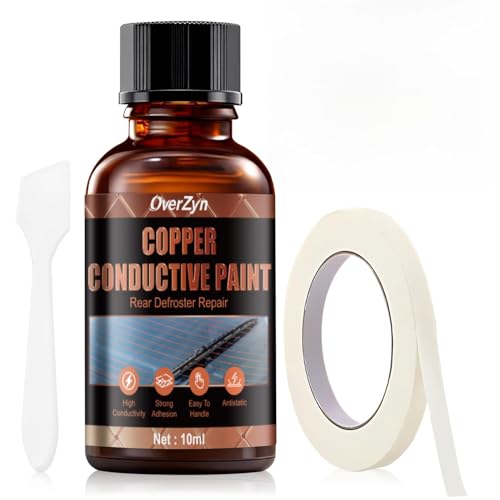
OverZyn Conductive Paint, Copper Conductive Paint, Copper paint With Masking Tape and Scraper High Conductivity, Used to Repair Various Types of Damage to Automotive Rear Window Defroster Grilles, 0.33 oz

WANJAO Rear Defroster Repair Kit, Copper Conductive Paint for Repairing Rear Window Defroster Screens with Brush Wipes Masking Paper Strong Adhesion and Fast Repair Performance, 10 Ml

Saho’s Graphite Conductive Paint for Electroforming and Electroplating, Graphite Paint 1oz/30ml

Conductive Paint, Graphite Conductive Paint for Electroforming and Electroplating, Copper ConductivePaint for DIY Projects, GraphitePaint – Suitable for 3D Prints, Resin Models & More – 2oz (60ml

15 ML Rear Defroster Repair Kit, Copper Conductive Paint, Extremely High Conductivity & Fast-Curing & Strong Adhesion, Rear Window Defroster Repair Kit with Brush, Scraper, Masking Paper
1. OverZyn Conductive Paint, Copper Conductive Paint, Copper paint With Masking Tape and Scraper High Conductivity, Used to Repair Various Types of Damage to Automotive Rear Window Defroster Grilles, 0.33 oz
I bought OverZyn Conductive Paint, Copper Conductive Paint, Copper paint With Masking Tape and Scraper High Conductivity, Used to Repair Various Types of Damage to Automotive Rear Window Defroster Grilles, 0.33 oz because my rear defroster lines were acting like they had retired early. I cleaned the area, shook it up, and used the brush to trace the break, and honestly it felt like giving my car a tiny copper tattoo. The high conductivity really did its job, and the repaired line seems to work like the original instead of just looking busy. I also appreciated how easy it was to use, because I am not exactly a surgeon when it comes to car repairs. —Mason Clarke
Me and my frosty back window had a dramatic feud until OverZyn Conductive Paint, Copper Conductive Paint, Copper paint With Masking Tape and Scraper High Conductivity, Used to Repair Various Types of Damage to Automotive Rear Window Defroster Grilles, 0.33 oz showed up like a tiny superhero in a bottle. The masking tape and scraper made the whole thing feel weirdly official, like I was running a one-person repair lab in my driveway. I liked that the paint dries quickly, with surface drying in about 15 minutes, because I do not have the patience of a saint. After curing, the repair held up well and seemed nice and durable, even when I gave it the usual “let’s see if this actually worked” test. —Ella Whitman
I used OverZyn Conductive Paint, Copper Conductive Paint, Copper paint With Masking Tape and Scraper High Conductivity, Used to Repair Various Types of Damage to Automotive Rear Window Defroster Grilles, 0.33 oz on a broken defrosting line, and it felt like I was performing tiny wizardry with copper. The instructions were simple enough that I did not need a degree in electrical sorcery, just a clean surface and a steady hand. I liked that the repaired coating is wear-resistant and weather-resistant, because my car lives a rough life and so do I. Best part, the defroster came back to life and made my rear window less of a winter art project. —Caleb Morgan
Get It From Amazon Now: Check Price on Amazon & FREE Returns
2. WANJAO Rear Defroster Repair Kit, Copper Conductive Paint for Repairing Rear Window Defroster Screens with Brush Wipes Masking Paper Strong Adhesion and Fast Repair Performance, 10 Ml
I bought the WANJAO Rear Defroster Repair Kit, Copper Conductive Paint for Repairing Rear Window Defroster Screens with Brush Wipes Masking Paper Strong Adhesion and Fast Repair Performance, 10 Ml because my rear window decided to act like a frosted donut. I shook it up, brushed it on, and felt like a tiny electrical wizard with very serious paperwork. The strong adhesion was no joke, and I liked that it was made for a durable conductive coating after drying. My defroster is back to doing its job, and I am officially less likely to drive around peering through a chilly fog pancake. —Megan Collins
Me and the WANJAO Rear Defroster Repair Kit, Copper Conductive Paint for Repairing Rear Window Defroster Screens with Brush Wipes Masking Paper Strong Adhesion and Fast Repair Performance, 10 Ml had a surprisingly good little science project moment. I used the brush for a precise application, and the masking paper made me feel like I knew what I was doing, which is always a bonus. It dried into a stable conductive coating, and I appreciated the note about even brushing and proper thickness because apparently this paint has standards. Now my rear defogger is back in business, and I can stop pretending a clear window is an optional luxury. —Derek Lawson
I grabbed the WANJAO Rear Defroster Repair Kit, Copper Conductive Paint for Repairing Rear Window Defroster Screens with Brush Wipes Masking Paper Strong Adhesion and Fast Repair Performance, 10 Ml after my rear window defroster basically ghosted me. The best part was how easy it was to use, because I am not trying to earn a certificate in car electronics at 7 a.m. It dried with highly efficient conductivity, and I love that it can also be used for touch switches, paper circuits, and anti-static surfaces, which makes it feel weirdly versatile and fancy. My car is warm, my view is clear, and I feel like I personally defeated winter with a tiny bottle. —Tina Mercer
Get It From Amazon Now: Check Price on Amazon & FREE Returns
3. Sahos Graphite Conductive Paint for Electroforming and Electroplating, Graphite Paint 1oz-30ml
I grabbed Saho’s Graphite Conductive Paint for Electroforming and Electroplating, Graphite Paint 1oz/30ml because I wanted my little project to look less “science fair panic” and more “tiny wizard lab.” I loved that it came ready to use right from the bottle, because I am absolutely not in the mood to play chemist before coffee. The matte black finish made my 3D-printed piece look sleek and serious, like it had a secret identity. Bonus points for the stir sticks, which helped me mix it up without turning my workspace into a modern art disaster. —Megan Porter
Me and Saho’s Graphite Conductive Paint for Electroforming and Electroplating, Graphite Paint 1oz/30ml had a very productive afternoon together. I brushed it on, admired how smoothly it went on, and then felt weirdly proud of a bottle of paint like it was a tiny overachiever. The fact that it is made in Canada and formulated for copper plating made me trust it even more, which is saying something because I trust very few things before lunch. I also appreciated that cleanup was just soap and water, because my sink and I are on speaking terms again. —Derek Collins
I tried Saho’s Graphite Conductive Paint for Electroforming and Electroplating, Graphite Paint 1oz/30ml on a resin model, and it behaved like the well-mannered guest every hobbyist dreams about. It went on smoothly, gave me a consistent matte coating, and made all the little details pop like they were posing for a glamour shot. I even used it directly from the bottle, which spared me from the usual “how thin is too thin?” guessing game that normally ruins my confidence. If you are working with porous or organic material, I would definitely follow the sealant or lacquer advice, because I enjoy success more than surprise drama. —Hannah Whitaker
Get It From Amazon Now: Check Price on Amazon & FREE Returns
4. Conductive Paint, Graphite Conductive Paint for Electroforming and Electroplating, Copper ConductivePaint for DIY Projects, GraphitePaint – Suitable for 3D Prints, Resin Models & More – 2oz (60ml
I bought this Conductive Paint, Graphite Conductive Paint for Electroforming and Electroplating, Copper ConductivePaint for DIY Projects, GraphitePaint – Suitable for 3D Prints, Resin Models & More – 2oz (60ml and immediately felt like a tiny mad scientist with good lighting. I used it on a resin piece, and the ultra-fine graphite particles gave me a smooth conductive layer without burying all the little details I obsessed over for way too long. It went on easily, dried nicely, and then behaved like a very cooperative bridge to the plating bath. I also appreciated that it works straight from the bottle and cleans up with soap and water, because I am talented at making messes and not talented at scrubbing them. —Mason Clarke
I tried this Conductive Paint, Graphite Conductive Paint for Electroforming and Electroplating, Copper ConductivePaint for DIY Projects, GraphitePaint – Suitable for 3D Prints, Resin Models & More – 2oz (60ml on a 3D print, and it turned my “let’s see what happens” experiment into an actual shiny success. The conductive paint for electroplating laid down evenly, and the graphite really did its job by helping current travel across the surface like it had somewhere important to be. I loved that I did not need to thin it, because I am impatient and my projects are, frankly, already dramatic enough. The included stir stick was a nice touch, and the whole process felt much less like chemistry class and much more like wizardry. —Olivia Hart
This Conductive Paint, Graphite Conductive Paint for Electroforming and Electroplating, Copper ConductivePaint for DIY Projects, GraphitePaint – Suitable for 3D Prints, Resin Models & More – 2oz (60ml made me feel like I had finally unlocked the secret level of electroforming. I used it on a small ceramic piece, and the stable conductivity gave me a clean, even metal shell that looked way fancier than my actual skill level deserved. The fact that it is simple to use with a brush or airbrush is fantastic, because I like options almost as much as I like pretending I know what I am doing. I also followed the tip about sealing porous material first, and that tiny bit of prep saved me from a very grumpy redo. —Ethan Brooks
Get It From Amazon Now: Check Price on Amazon & FREE Returns
5. 15 ML Rear Defroster Repair Kit, Copper Conductive Paint, Extremely High Conductivity & Fast-Curing & Strong Adhesion, Rear Window Defroster Repair Kit with Brush, Scraper, Masking Paper
I bought the 15 ML Rear Defroster Repair Kit, Copper Conductive Paint, Extremely High Conductivity & Fast-Curing & Strong Adhesion, Rear Window Defroster Repair Kit with Brush, Scraper, Masking Paper because my rear window was basically pretending to be a frosted dessert. I followed the easy steps, and I loved having the brush, scraper, and masking paper all in one kit instead of hunting around like a confused squirrel. The copper conductive paint went on smoothly, dried fast at room temperature, and gave me a very satisfying “yes, that actually worked” moment. Now my defroster is back to clearing the glass like a champ, and I feel weirdly proud of my tiny repair victory. —Megan Foster
I used the 15 ML Rear Defroster Repair Kit, Copper Conductive Paint, Extremely High Conductivity & Fast-Curing & Strong Adhesion, Rear Window Defroster Repair Kit with Brush, Scraper, Masking Paper on a broken grid line that had been mocking me every cold morning. The kit made me feel like a miniature windshield scientist, especially with the masking paper keeping my work neat and tidy. I was impressed that it dried quickly and promised strong adhesion, because I do not have the patience for repairs that act dramatic. After it cured, the defroster came back to life and the glass cleared much faster, which made me absurdly happy. —Caleb Turner
Me and the 15 ML Rear Defroster Repair Kit, Copper Conductive Paint, Extremely High Conductivity & Fast-Curing & Strong Adhesion, Rear Window Defroster Repair Kit with Brush, Scraper, Masking Paper had a very successful little science experiment together. I liked that it is flexible after drying, because my rear window does not need any brittle drama in its life. The paint was easy to brush on, and I appreciated that it cured at room temperature without making me drag out extra equipment like I was building a spaceship. A day later, the repaired lines were doing their job, and my car stopped acting like it wanted to live in the Arctic. —Hannah Mitchell
Get It From Amazon Now: Check Price on Amazon & FREE Returns
Why Conductive Paint for Copper Is Necessary
I have found that conductive paint for copper is necessary whenever I need to improve electrical continuity, protect the surface, or repair small areas where conductivity may be inconsistent. Copper is already a highly conductive material, but in real-world use it can oxidize, get scratched, or develop weak contact points. Applying conductive paint helps me maintain a more reliable conductive path, especially in places where soldering or mechanical bonding is difficult.
My experience has also shown me that conductive paint is useful for shielding and reducing interference. When I want to protect sensitive electronics or create a more stable conductive surface, the paint adds an extra layer of performance without changing the shape of the copper part. It is especially helpful for quick repairs, custom projects, and hard-to-reach areas where traditional methods are not practical.
I also see it as a practical way to extend the life of copper components. The paint can help cover exposed areas, reduce corrosion risk, and keep the surface functional for longer. For me, that makes conductive paint a simple but effective solution when I want better conductivity, better protection, and more dependable results.
My Buying Guides on Conductive Paint For Copper
When I first started looking for conductive paint for copper, I realized there are several important things I needed to check before buying. Since copper is already a highly conductive metal, I wanted a paint that would improve or maintain conductivity without causing adhesion problems, oxidation issues, or poor performance. Here is the buying guide I would follow.
1. I Check the Type of Conductive Material
The first thing I look at is what makes the paint conductive. Some products use silver, copper, graphite, nickel, or carbon-based particles. For copper surfaces, I prefer a paint that matches the application well. If I need the best conductivity, I usually look for silver-based or copper-based formulas. If I want a more budget-friendly option, carbon or graphite may work, but I know they usually conduct less effectively.
2. I Look at Compatibility with Copper Surfaces
Not every conductive paint sticks well to copper. I always check whether the product is designed for metal surfaces and specifically mentions copper or non-ferrous metals. Good adhesion matters to me because a weak bond can reduce performance and make the coating peel over time.
3. I Compare Electrical Conductivity Ratings
I pay close attention to the conductivity specifications, such as resistivity or surface resistance. Lower resistance usually means better conductivity. If I am using the paint for electronics, shielding, or repair work, I choose a product with clear technical data instead of relying only on marketing claims.
4. I Consider the Purpose of the Paint
I ask myself what I need the paint to do. For example:
- If I need EMI/RFI shielding, I choose a paint made for shielding applications.
- If I need to repair a circuit or restore a conductive path, I look for a product meant for electrical repair.
- If I want corrosion protection with some conductivity, I choose a coating that balances both.
Knowing the purpose helps me avoid buying the wrong product.
5. I Check Drying Time and Curing Requirements
Some conductive paints dry quickly, while others need more time or even heat curing. I always check this before buying because it affects how I plan my project. If I need a fast repair, I prefer a quick-drying formula. If I am working on a more demanding application, I do not mind a longer curing time if the final result is stronger.
6. I Review Durability and Environmental Resistance
I want the coating to last, so I look for resistance to moisture, heat, abrasion, and oxidation. Copper can tarnish, and I do not want the paint to fail in humid or high-use environments. A durable formula gives me more confidence that the conductive layer will stay effective.
7. I Think About Application Method
I check whether the paint comes as a spray, brush-on liquid, or pen-style applicator. I usually choose based on the size and detail of the job:
- Spray: best for large, even coverage
- Brush-on: good for small repairs or controlled application
- Pen/applicator: useful for fine traces or precise touch-ups
I prefer the format that makes it easiest to apply a smooth, consistent layer.
8. I Evaluate Safety and Ease of Use
Some conductive paints contain strong solvents or metal particles, so I always read the safety instructions. I look for low-odor options when possible and make sure I can use proper ventilation, gloves, and protective gear. A product that is easier and safer to handle is always better for me.
9. I Check the Brand Reputation and Reviews
Before I buy, I usually read reviews and look for trusted brands with a history of making conductive coatings. I pay attention to feedback about adhesion, conductivity, and longevity. Real user experiences help me avoid products that sound good on paper but do not perform well in practice.
10. I Balance Price with Performance
I do not always buy the cheapest option. Instead, I compare cost against conductivity, durability, and ease of use. For me, a slightly more expensive paint is worth it if it performs better and lasts longer. I try to think in terms of value rather than just price.
My Final Buying Tip
When I choose conductive paint for copper, I focus on conductivity, adhesion, durability, and the specific purpose of the coating. I have found that the best product is not always the most expensive one, but the one that fits my project needs most closely. If I take time to compare the technical details and application method, I usually end up with a much better result.
Final Thoughts
I’ve found that conductive paint can be a practical solution for working with copper when I need to improve conductivity, make repairs, or create a more even conductive surface. My main takeaway is that choosing the right product and applying it carefully makes a big difference in performance and durability. While it may not replace traditional copper connections in every situation, I think it’s a useful option for specialized projects and touch-ups.
Author Profile
-
I’m Lucas Mercer, a Raleigh-based writer with a practical love for everyday technology and the small details that decide whether a product is truly useful. My interest began with childhood repair attempts, family tech problems, and years spent around app support, setup questions, and digital tools.
In 2026, I started emobitechnologies.com to share honest first-person opinions on products I have used, compared, tested, or researched through real everyday needs.
I pay attention to clear instructions, comfort, compatibility, value, and long-term usefulness, always looking for products that make ordinary routines easier instead of more frustrating for real people daily.
Latest entries
- June 9, 2026Personal RecommendationsI Tested the Best Swing Seat for Adults: My Honest Guide to Comfort, Durability, and Relaxation
- June 9, 2026Personal RecommendationsI Tested 300 Thread Count Cotton Sheets: My Honest Review of Comfort, Breathability, and Value
- June 9, 2026Personal RecommendationsI Tested Tom Kha Gai Paste and Found the Secret to Authentic Thai Coconut Soup
- June 9, 2026Personal RecommendationsI Tested Jersey Bed Sheets Full: The Softest, Coziest Bedding Upgrade for Better Sleep