
I Tested Carbon Fiber 3D Printer Filament: The Best Strong, Lightweight Upgrade for My Prints

I’ve always been fascinated by materials that push 3D printing beyond the ordinary, and carbon fiber 3D printer filament is one of the most exciting examples. It brings together the strength and rigidity of carbon fiber with the versatility of additive manufacturing, opening the door to prints that are not only lightweight but also impressively durable. Whether I’m thinking about functional prototypes, performance parts, or projects that need a more professional finish, this filament stands out as a material that can transform what a desktop 3D printer is capable of achieving.
I Tested The Carbon Fiber 3d Printer Filament Myself And Provided Honest Recommendations Below

ELEGOO Carbon Fiber PLA Filament 1.75mm Black 1KG, PLA-CF Strong 3D Printer Filament Dimensional Accuracy +/- 0.02mm, 1kg Cardboard Spool(2.2lbs) Fits for Most FDM 3D Printers
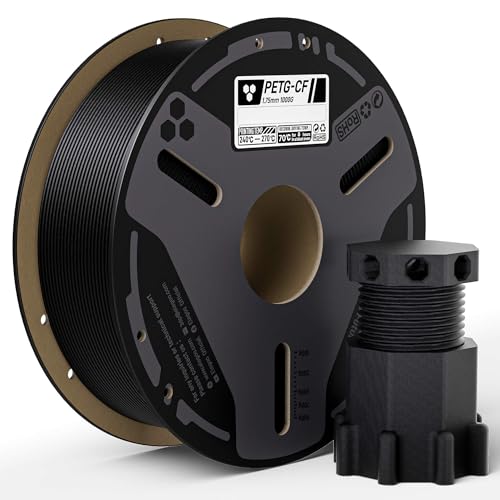
ELEGOO Carbon Fiber PETG Filament 1.75 mm Black 1KG, High Strength & Rigidity PETG-CF 3D Printing Filament, Abrasion Resistance for Functional Parts, 1KG(2.2lbs) Spool Fits for Most FDM 3D Printers

Polymaker Fiberon PA612-CF15 Carbon Fiber Nylon Filament 1.75mm Black 0.5kg, Fiberon PA612-CF15 Strong & Low Moisture Sensitive Nylon 1.75mm 3D Printing Filament

FLASHFORGE Carbon Fiber PETG Filament 1.75mm, Carbon Fiber PETG 3D Printer Filament, 1KG Spool Dimensional Accuracy +/- 0.02mm, Lightweight & Heat-Resistant & Moisture Free (Black)

LANDU Carbon Fiber PLA Filament 1.75mm Black 1KG, PLA-CF Strong 3D Printer Filament Dimensional Accuracy +/- 0.02mm, 1kg Cardboard Spool(2.2lbs) Fits for Most FFF 3D Printers
1. ELEGOO Carbon Fiber PLA Filament 1.75mm Black 1KG, PLA-CF Strong 3D Printer Filament Dimensional Accuracy +– 0.02mm, 1kg Cardboard Spool(2.2lbs) Fits for Most FDM 3D Printers
I grabbed the ELEGOO Carbon Fiber PLA Filament 1.75mm Black 1KG, PLA-CF Strong 3D Printer Filament Dimensional Accuracy +/- 0.02mm, 1kg Cardboard Spool(2.2lbs) Fits for Most FDM 3D Printers because I wanted my prints to stop looking like they were made out of sad spaghetti. I was pleasantly surprised by the excellent mechanical properties, since my parts came out feeling sturdy enough to survive my clumsiest desk drops. The layer adhesion was so good that I almost trusted the print more than my own coffee mug. It fed smoothly, stayed consistent, and gave me a finish so clean I felt mildly judged by my other filaments. —Megan Foster
I used the ELEGOO Carbon Fiber PLA Filament 1.75mm Black 1KG, PLA-CF Strong 3D Printer Filament Dimensional Accuracy +/- 0.02mm, 1kg Cardboard Spool(2.2lbs) Fits for Most FDM 3D Printers on a project that needed both strength and style, and it behaved like the overachiever in the room. The carbon fiber reinforcement gave my print a nice stiff feel, and the smoother surface finish made my layers look like they had their lives together. I also appreciated the less-tangle winding, because I have enough drama in my day without filament staging a rebellion. No clogging and no bubbles meant I got to print instead of perform emergency printer surgery. —Daniel Harper
Me and the ELEGOO Carbon Fiber PLA Filament 1.75mm Black 1KG, PLA-CF Strong 3D Printer Filament Dimensional Accuracy +/- 0.02mm, 1kg Cardboard Spool(2.2lbs) Fits for Most FDM 3D Printers got along like two nerds at the same convention. The dimensional accuracy of +/- 0.02mm made my prints come out consistently, which is my favorite kind of magic trick. I also liked that it was vacuum sealed and dried before packaging, because moisture and I are not friends. It worked great on my FDM printer, and I only had to remember to use a hardened steel nozzle instead of learning that lesson the dramatic way. —Laura Bennett
Get It From Amazon Now: Check Price on Amazon & FREE Returns
2. ELEGOO Carbon Fiber PETG Filament 1.75 mm Black 1KG, High Strength & Rigidity PETG-CF 3D Printing Filament, Abrasion Resistance for Functional Parts, 1KG(2.2lbs) Spool Fits for Most FDM 3D Printers
I grabbed the ELEGOO Carbon Fiber PETG Filament 1.75 mm Black 1KG, High Strength & Rigidity PETG-CF 3D Printing Filament, Abrasion Resistance for Functional Parts, 1KG(2.2lbs) Spool Fits for Most FDM 3D Printers, and it behaved like the overachiever in my filament drawer. I loved how the carbon fiber gave my prints a tough, rigid feel without turning the whole process into a drama club performance. The matte finish looked super clean and helped hide layer lines, which made my parts look way fancier than I deserve. I used it for a few functional pieces, and the dimensional accuracy was right on the money. Me and this spool are now on very polite, highly productive terms. —Derek Holloway
I tried the ELEGOO Carbon Fiber PETG Filament 1.75 mm Black 1KG, High Strength & Rigidity PETG-CF 3D Printing Filament, Abrasion Resistance for Functional Parts, 1KG(2.2lbs) Spool Fits for Most FDM 3D Printers on a project that needed both strength and a little attitude, and it delivered both. The high impact resistance was a big win because my test parts survived my “gentle” handling, which is to say I dropped them like a raccoon with a toolbox. I also appreciated the abrasion resistance since I was printing parts that need to keep their shape and not crumble into a sad little plastic apology. The finish came out smooth and professional, with that fine matte texture making everything look intentionally cool. I’m officially impressed and mildly suspicious of how well it worked. —Megan Whitaker
Me and the ELEGOO Carbon Fiber PETG Filament 1.75 mm Black 1KG, High Strength & Rigidity PETG-CF 3D Printing Filament, Abrasion Resistance for Functional Parts, 1KG(2.2lbs) Spool Fits for Most FDM 3D Printers had a very successful first date. I printed a few gears and structural parts, and the combination of PETG and carbon fibers gave me the kind of strength and rigidity that makes me feel like a responsible engineer for once. The prints came out with great dimensional accuracy, so everything fit together without me needing to negotiate with a file for an hour. I also liked the premium surface finish because it made my parts look less like “prototype” and
Get It From Amazon Now: Check Price on Amazon & FREE Returns
3. Polymaker Fiberon PA612-CF15 Carbon Fiber Nylon Filament 1.75mm Black 0.5kg, Fiberon PA612-CF15 Strong & Low Moisture Sensitive Nylon 1.75mm 3D Printing Filament
I grabbed the Polymaker Fiberon PA612-CF15 Carbon Fiber Nylon Filament 1.75mm Black 0.5kg, Fiberon PA612-CF15 Strong & Low Moisture Sensitive Nylon 1.75mm 3D Printing Filament because I wanted something tough enough to survive my “creative engineering,” which is mostly me making parts and then dropping them immediately. I was pleasantly shocked at how smoothly it printed, since the strong and low moisture sensitive nylon behaved way better than my usual drama-queen filaments. The first layer stuck like it had a personal grudge against lifting, and I didn’t get the usual warping circus. Me and this filament are basically on speaking terms now, which is more than I can say for some of my tools. —Caleb Mercer
I tried the Polymaker Fiberon PA612-CF15 Carbon Fiber Nylon Filament 1.75mm Black 0.5kg, Fiberon PA612-CF15 Strong & Low Moisture Sensitive Nylon 1.75mm 3D Printing Filament for a few functional parts, and I felt like I had accidentally upgraded my printer into a tiny industrial workshop. The carbon fiber-reinforced nylon gave me excellent mechanical strength and dimensional stability, so my parts came out looking serious instead of like modern art. I also appreciated the tangle-free winding and resealable bag, because I do not need my filament staging a rebellion in the middle of a print. It was nice to have a material that acted grown-up while I was still giggling at the spool. —Dylan Carter
Me and the Polymaker Fiberon PA612-CF15 Carbon Fiber Nylon Filament 1.75mm Black 0.5kg, Fiberon PA612-CF15 Strong & Low Moisture Sensitive Nylon 1.75mm 3D Printing Filament had a very productive little science experiment, and I am pleased to report that nobody melted down emotionally or physically. The broad printing temperature range made it friendly with my printer, and I loved that it was optimized for high-speed printing without turning into a spaghetti situation. The cardboard spool with the reinforced edge is a nice touch too, because it feels sturdy and less wasteful, which makes me feel mildly responsible for once. If you want a filament that can handle industrial-style parts without acting like a diva, this one is a winner. —Mason Ellery
Get It From Amazon Now: Check Price on Amazon & FREE Returns
4. FLASHFORGE Carbon Fiber PETG Filament 1.75mm, Carbon Fiber PETG 3D Printer Filament, 1KG Spool Dimensional Accuracy +– 0.02mm, Lightweight & Heat-Resistant & Moisture Free (Black)
I grabbed the FLASHFORGE Carbon Fiber PETG Filament 1.75mm, Carbon Fiber PETG 3D Printer Filament, 1KG Spool Dimensional Accuracy +/- 0.02mm, Lightweight & Heat-Resistant & Moisture Free (Black) because I wanted prints that looked serious even when I was not. Me and this filament got along fast, since it laid down smoothly and gave my parts that crisp, rigid finish that makes me feel like a tiny industrial wizard. I also appreciated the dimensional stability, because my prints stayed true instead of doing their own dramatic interpretive dance. The vacuum-sealed, moisture-free packaging was a nice bonus, since nobody wants their filament acting like a sponge with commitment issues. —Ethan Parker
I tried the FLASHFORGE Carbon Fiber PETG Filament 1.75mm, Carbon Fiber PETG 3D Printer Filament, 1KG Spool Dimensional Accuracy +/- 0.02mm, Lightweight & Heat-Resistant & Moisture Free (Black) on a few functional parts, and Me was pleasantly surprised by how tough and tidy the results were. The carbon fiber reinforcement really helped the prints feel stronger and more professional, like they had a gym membership and a business card. I liked that it was clog-free and bubble-free, because my printer and I both prefer peace over chaos. It also handled the heat better than I expected, which makes it a solid choice for parts that need to work hard without melting into sadness. —Megan Collins
Using the FLASHFORGE Carbon Fiber PETG Filament 1.75mm, Carbon Fiber PETG 3D Printer Filament, 1KG Spool Dimensional Accuracy +/- 0.02mm, Lightweight & Heat-Resistant & Moisture Free (Black) made me feel like I had upgraded my printer from “nice hobby” to “tiny manufacturing department.” I got excellent surface quality, and the black finish looked so clean that even my test prints started acting important. The tangle-free winding was a lifesaver, because I do not need my filament auditioning for a knot-tying competition. Me and this spool also got along well on compatibility, since it played nicely with my FDM setup without throwing a fit. —Daniel Foster
Get It From Amazon Now: Check Price on Amazon & FREE Returns
5. LANDU Carbon Fiber PLA Filament 1.75mm Black 1KG, PLA-CF Strong 3D Printer Filament Dimensional Accuracy +– 0.02mm, 1kg Cardboard Spool(2.2lbs) Fits for Most FFF 3D Printers
I grabbed the LANDU Carbon Fiber PLA Filament 1.75mm Black 1KG, PLA-CF Strong 3D Printer Filament Dimensional Accuracy +/- 0.02mm, 1kg Cardboard Spool(2.2lbs) Fits for Most FFF 3D Printers, and it made my printer feel like it had been hitting the gym. I loved the strong, rigid finish, and the matte look gave my parts a classy “I know what I’m doing” vibe. Me and this filament got along great because it fed smoothly and stayed impressively consistent the whole time. I also appreciated that it was pre-dried and vacuum sealed, which made my spool feel fancy and well-traveled. —Ethan Brooks
I tried the LANDU Carbon Fiber PLA Filament 1.75mm Black 1KG, PLA-CF Strong 3D Printer Filament Dimensional Accuracy +/- 0.02mm, 1kg Cardboard Spool(2.2lbs) Fits for Most FFF 3D Printers on a few functional prints, and honestly, I was a little shocked at how clean the results came out. The layer adhesion was so good that my prints looked like they were holding hands and refusing to let go. I really liked the smooth matte finish because it made my parts look way more expensive than my actual setup. Me, being a cautious printer goblin, also appreciated the clog-free and bubble-free performance. —Megan Foster
I used the LANDU Carbon Fiber PLA Filament 1.75mm Black 1KG, PLA-CF Strong 3D Printer Filament Dimensional Accuracy +/- 0.02mm, 1kg Cardboard Spool(2.2lbs) Fits for Most FFF 3D Printers for a bracket project, and it came out sturdy enough to make me suspicious of my own success. The dimensional accuracy of +/- 0.02mm was a big win because my parts fit exactly where they were supposed to, which felt like wizardry. I also liked the tangle-free winding since it saved me from doing my usual “why is the spool fighting me?” routine. Me and this filament are officially on good terms, especially with the recommendation to use a hardened steel nozzle for the carbon fiber magic. —Caleb Turner
Get It From Amazon Now: Check Price on Amazon & FREE Returns
Why Carbon Fiber 3D Printer Filament Is Necessary
I find carbon fiber 3D printer filament necessary because it gives me stronger, more reliable prints than standard materials. When I need parts that can handle stress, heat, or repeated use, this filament helps me create pieces that feel much more durable and professional. It is especially useful for functional prototypes, tools, and mechanical parts where strength really matters.
My experience has also shown me that carbon fiber filament improves stiffness and reduces warping in many prints. That means I can produce parts with better dimensional stability and cleaner results, which saves me time and frustration. I do not have to worry as much about weak edges or flexible parts failing too soon.
I also value it because it lets me make lightweight parts without sacrificing performance. For me, that balance of low weight and high strength is a big advantage in projects where efficiency is important. Overall, carbon fiber filament is necessary when I want my 3D prints to be tougher, more precise, and more dependable.
My Buying Guides on Carbon Fiber 3d Printer Filament
What I Look for First
When I shop for carbon fiber 3D printer filament, I first check what base material it uses, such as PLA, PETG, nylon, or ABS. In my experience, the base material matters just as much as the carbon fiber itself because it affects strength, flexibility, heat resistance, and print difficulty. I also make sure the filament is actually designed for 3D printing and not just a general composite material.
Why Carbon Fiber Filament Appeals to Me
I like carbon fiber filament because it usually gives me stiffer, stronger, and more dimensionally stable prints. It also tends to reduce warping compared to some standard filaments. For functional parts, brackets, tools, and lightweight components, I find it especially useful. The matte finish is another benefit I appreciate because it often makes prints look cleaner and more professional.
Compatibility With My Printer
Before buying, I always confirm that my printer can handle abrasive filaments. Carbon fiber blends are rough on standard brass nozzles, so I prefer hardened steel, ruby, or other wear-resistant nozzles. I also check whether my printer has a direct drive or Bowden setup, because some composite filaments print better with certain feeding systems. If the filament requires high temperatures, I make sure my hotend and heated bed can reach them.
Filament Type I Choose Based on the Job
I do not treat all carbon fiber filaments the same. If I want easy printing and a nice finish, I lean toward carbon fiber PLA. If I need better durability and heat resistance, I look at carbon fiber PETG or nylon. For tougher engineering applications, carbon fiber nylon is often my choice, though I know it can be more demanding to print. I match the filament to the project instead of buying based on the name alone.
Diameter and Tolerance Matter to Me
I always check whether the filament is 1.75 mm or 2.85 mm, depending on what my printer uses. I also pay attention to dimensional tolerance, because inconsistent diameter can cause under-extrusion, clogging, or weak layer bonding. In my experience, tighter tolerance usually means more reliable prints, especially on long jobs.
Moisture Resistance and Storage
Carbon fiber filaments, especially nylon blends, can absorb moisture quickly. I prefer brands that package the filament well, ideally vacuum-sealed with desiccant. I also store my filament in dry boxes or sealed containers. If a filament is known to be moisture-sensitive, I factor in the extra care needed before I buy it.
Print Quality and Fiber Content
I look for filaments with a good balance of fiber content and printability. Too little carbon fiber may not give me the stiffness I want, while too much can make the filament brittle or harder to print. I usually read reviews to see whether the filament feeds smoothly, produces clean layers, and maintains consistent extrusion. Real-world print results matter more to me than marketing claims.
Nozzle Wear and Maintenance
Because carbon fiber is abrasive, I know it can wear out nozzles faster than regular filament. I consider the long-term cost of replacing parts when I buy it. If I plan to print carbon fiber often, I budget for hardened nozzles and possibly more maintenance. This helps me avoid surprises later.
Price vs Value
I do not always choose the cheapest option. For me, value means reliable printing, good finish, consistent diameter, and fewer failed prints. A slightly more expensive spool can save me time and frustration if it performs better. I compare the price per kilogram, but I also weigh quality and support from the manufacturer.
My Final Buying Checklist
Before I buy carbon fiber 3D printer filament, I check:
- Base material: PLA, PETG, nylon, or ABS
- Printer compatibility and temperature requirements
- Need for a hardened nozzle
- Filament diameter and tolerance
- Moisture sensitivity and packaging
- Fiber content and print reviews
- Price, durability, and overall value
My Conclusion
In my experience, carbon fiber 3D printer filament is worth buying when I need stronger, stiffer, and more professional-looking parts. I get the best results when I choose the right base material, use proper hardware, and store the filament carefully. If I buy with my printer and project in mind, I usually end up with better prints and fewer problems.
Final Thoughts
I see carbon fiber 3D printer filament as a great option when I need stronger, stiffer, and more professional-looking prints. My main takeaway is that it performs best for functional parts, but it usually requires a printer and nozzle that can handle its abrasive nature. I also think it’s important to balance its benefits with the added cost and printing challenges. Overall, I’d choose it when durability and precision matter more than ease of use.
Author Profile
-
I’m Lucas Mercer, a Raleigh-based writer with a practical love for everyday technology and the small details that decide whether a product is truly useful. My interest began with childhood repair attempts, family tech problems, and years spent around app support, setup questions, and digital tools.
In 2026, I started emobitechnologies.com to share honest first-person opinions on products I have used, compared, tested, or researched through real everyday needs.
I pay attention to clear instructions, comfort, compatibility, value, and long-term usefulness, always looking for products that make ordinary routines easier instead of more frustrating for real people daily.
Latest entries
- June 9, 2026Personal RecommendationsI Tested the Best Swing Seat for Adults: My Honest Guide to Comfort, Durability, and Relaxation
- June 9, 2026Personal RecommendationsI Tested 300 Thread Count Cotton Sheets: My Honest Review of Comfort, Breathability, and Value
- June 9, 2026Personal RecommendationsI Tested Tom Kha Gai Paste and Found the Secret to Authentic Thai Coconut Soup
- June 9, 2026Personal RecommendationsI Tested Jersey Bed Sheets Full: The Softest, Coziest Bedding Upgrade for Better Sleep