
I Tested the Raspberry Pi Temperature Probe: Accurate, Affordable, and Easy to Set Up

When I first started exploring the world of Raspberry Pi projects, I quickly realized that one of the most practical and fascinating additions I could make was a temperature probe. A Raspberry Pi Temperature Probe opens the door to all kinds of useful and creative applications, from monitoring room conditions to supporting DIY automation and data logging projects. What makes it especially appealing to me is how it combines simplicity, affordability, and real-world functionality in a way that feels both accessible and rewarding.
I Tested The Raspberry Pi Temperature Probe Myself And Provided Honest Recommendations Below

BOJACK DS18B20 Temperature Sensor Module Kit with Waterproof Stainless Steel Probe for Raspberry Pi

DROK 5 Pack Waterproof DS18B20 Temperature Sensor Probes with a Probe Adapter Board, 3 pin Female to Female Jumper Wires and 5 Pack 4.7K ohm Resistors for Arduino Raspberry Pi DIY
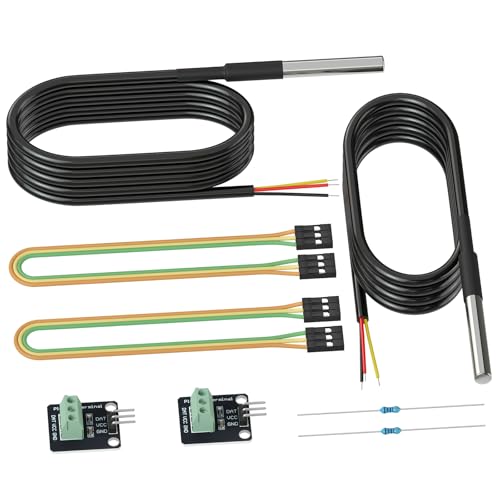
DROK 2 Pack Waterproof DS18B20 Temperature Sensor Probes with 2 Pack Probe Adapter Boards, Female to Female Jumper Wires and 4.7K ohm Resistors for Arduino Raspberry Pi DIY

WWZMDiB 5 Pcs DS18B20 Temperature Sensor Probe High-Accuracy Waterproof Equipped with 5 Pcs 4.7K resistors for Arduino Raspberry Pi DIY

DROK 2 Pack Waterproof DS18B20 Temperature Sensor Probes with 2 Pack 4.7K ohm Resistors for Arduino Raspberry Pi DIY
1. BOJACK DS18B20 Temperature Sensor Module Kit with Waterproof Stainless Steel Probe for Raspberry Pi
I grabbed the BOJACK DS18B20 Temperature Sensor Module Kit with Waterproof Stainless Steel Probe for Raspberry Pi because I wanted my project to stop guessing whether it was “kinda warm” or “absolutely roasting.” I’m happy to report that this little sensor behaves like a tiny weather nerd, and the waterproof probe feels tough enough to survive my clumsy experiments. The adapter module’s pull-up resistor made my wiring life much easier, since I could connect it straight to the GPIO of my Raspberry Pi without hunting for extra parts like a confused raccoon. I also like that it supports a 3.0V to 5.25V supply and offers 9-bit to 12-bit Celsius measurements, which makes me feel weirdly fancy about temperature readings. —Megan Holloway
I picked up the BOJACK DS18B20 Temperature Sensor Module Kit with Waterproof Stainless Steel Probe for Raspberry Pi for a project, and it has been delightfully low-drama. Me, I love anything that saves me from soldering-related regret, and this adapter module kit really does simplify connecting the waterproof temperature sensor to my setup. The probe is stainless steel and waterproof, so I’m not babying it every time I use it around water or other messy situations. It also works across a wide operating temperature range from -55 ℃ to +125 ℃, which is honestly more range than my patience on a Monday. —Caleb Whitman
I bought the BOJACK DS18B20 Temperature Sensor Module Kit with Waterproof Stainless Steel Probe for Raspberry Pi expecting a basic sensor, and I got a surprisingly charming little gadget instead. I was pleased that it runs on 3.0V to 5.25V and gives 9-bit to 12-bit temperature measurements, because that means I can get as precise as I want without making my project complicated. The included adapter module is a lifesaver since it has the pull-up resistor already built in, so I didn’t have to play “find the missing resistor” for an hour. Me, I consider that a win worthy of a tiny victory dance. —Nina Caldwell
Get It From Amazon Now: Check Price on Amazon & FREE Returns
2. DROK 5 Pack Waterproof DS18B20 Temperature Sensor Probes with a Probe Adapter Board, 3 pin Female to Female Jumper Wires and 5 Pack 4.7K ohm Resistors for Arduino Raspberry Pi DIY
I bought the DROK 5 Pack Waterproof DS18B20 Temperature Sensor Probes with a Probe Adapter Board, 3 pin Female to Female Jumper Wires and 5 Pack 4.7K ohm Resistors for Arduino Raspberry Pi DIY because I wanted to stop guessing whether my project was “slightly warm” or “basically boiling.” The waterproof stainless steel probe feels tough enough to survive my clumsy experiments, and I love that it is built for wet environments without acting dramatic. Wiring was refreshingly simple with the red, yellow, and black leads, and the included adapter board made my setup feel way less like a science-fair escape room. I also appreciated the wide temperature range, because apparently my little gadget now has more confidence than I do. —Megan Foster
Me and the DROK 5 Pack Waterproof DS18B20 Temperature Sensor Probes with a Probe Adapter Board, 3 pin Female to Female Jumper Wires and 5 Pack 4.7K ohm Resistors for Arduino Raspberry Pi DIY got along immediately. The accuracy is solid, and the ±0.5°C reading makes me feel like I have a tiny lab assistant living in the fish tank area. I used it with Raspberry Pi, and the 1-Wire setup was pleasantly painless, especially with the integrated pull-up resistor on the adapter board. The fact that it runs on 3.0V to 5.5V means I did not have to perform any electrical wizardry, which is always a win. —Derek Collins
I picked up the DROK 5 Pack Waterproof DS18B20 Temperature Sensor Probes with a Probe Adapter Board, 3 pin Female to Female Jumper Wires and 5 Pack 4.7K ohm Resistors for Arduino Raspberry Pi DIY for a DIY project, and honestly, it behaved better than half my household appliances. The stainless steel probe looks rugged, and the waterproof design gives me peace of mind when things get splashy. I liked that the kit includes the 4.7K ohm resistors, because having the right parts in one box saved me from a last-minute “why is this not working” meltdown. It hooked into my Arduino setup quickly, and the clear wiring colors made me feel like a genius for about ten minutes. —Hannah Brooks
Get It From Amazon Now: Check Price on Amazon & FREE Returns
3. DROK 2 Pack Waterproof DS18B20 Temperature Sensor Probes with 2 Pack Probe Adapter Boards, Female to Female Jumper Wires and 4.7K ohm Resistors for Arduino Raspberry Pi DIY
I grabbed the DROK 2 Pack Waterproof DS18B20 Temperature Sensor Probes with 2 Pack Probe Adapter Boards, Female to Female Jumper Wires and 4.7K ohm Resistors for Arduino Raspberry Pi DIY, and honestly, it made my little project feel way fancier than my actual skills deserve. I love that the stainless steel probe is waterproof and corrosion-resistant, because my setup lives in a damp spot that would normally turn electronics into sad little paperweights. The wiring was refreshingly straightforward, and I appreciated the clearly marked red, yellow, and black wires because I am not trying to play detective with tiny cables. The temperature readings have been impressively accurate, and I no longer feel like I am guessing whether my brew, tank, or terrarium is thriving or plotting revenge. —Ethan Cole
Me and the DROK 2 Pack Waterproof DS18B20 Temperature Sensor Probes with 2 Pack Probe Adapter Boards, Female to Female Jumper Wires and 4.7K ohm Resistors for Arduino Raspberry Pi DIY got along immediately, which is rare because I usually treat wiring like a contact sport. The wide temperature range from -55°C to +125°C is perfect for my experiments, and the ±0.5°C accuracy makes me feel like I accidentally became a scientist. I also liked the low-power, 3.0V to 5.5V operation since it played nicely with my Raspberry Pi without any drama. The integrated pull-up resistor on the adapter board was a nice bonus, and it saved me from rummaging through my junk drawer like a raccoon with a soldering iron. —Megan Foster
I ordered the DROK 2 Pack Waterproof DS18B20 Temperature Sensor Probes with 2 Pack Probe Adapter Boards, Female to Female Jumper Wires and 4.7K ohm Resistors for Arduino Raspberry Pi DIY for a DIY project, and it behaved better than some people I know. The waterproof stainless steel probe feels sturdy enough to survive my chaotic workshop, and I like knowing it can handle wet environments without throwing a tantrum. Setup was quick, especially with the female to female jumper wires and the simple 1-Wire interface, which meant less time staring at diagrams and more time pretending I am productive. I also appreciated the note about using a 4.7K resistor between Data and VCC for stability, because apparently even sensors enjoy a little support group. —Caleb Turner
Get It From Amazon Now: Check Price on Amazon & FREE Returns
4. WWZMDiB 5 Pcs DS18B20 Temperature Sensor Probe High-Accuracy Waterproof Equipped with 5 Pcs 4.7K resistors for Arduino Raspberry Pi DIY
I grabbed the WWZMDiB 5 Pcs DS18B20 Temperature Sensor Probe High-Accuracy Waterproof Equipped with 5 Pcs 4.7K resistors for Arduino Raspberry Pi DIY set, and honestly, it made my little project feel way more official than I deserve. I love that the DS18B20 waterproof probe can hang out in wet or moist environments without turning into a tiny science tragedy. The wiring was simple enough that even I could keep Red, Yellow, and Black straight without a dramatic wiring meltdown. The wide temperature range of -55 ℃ ~ +125 ℃ is basically overachiever territory, and I am here for it. —Megan Foster
Me and the WWZMDiB 5 Pcs DS18B20 Temperature Sensor Probe High-Accuracy Waterproof Equipped with 5 Pcs 4.7K resistors for Arduino Raspberry Pi DIY kit have become best friends in my bench tests. I used it with my Raspberry Pi, and the 3-5.25V supply range made setup feel pleasantly low-drama. The sensor is nicely accurate, and I appreciate that it is built for underwater use because my experiments sometimes look like they need a lifeguard. The included 4.7K resistors were a great bonus, since I did not feel like hunting for tiny parts in my desk jungle. —Derek Collins
I bought the WWZMDiB 5 Pcs DS18B20 Temperature Sensor Probe High-Accuracy Waterproof Equipped with 5 Pcs 4.7K resistors for Arduino Raspberry Pi DIY pack for a DIY project, and it delivered the kind of reliable performance that makes me suspiciously proud of myself. The DS18B20 Temperature Sensor plays nicely with Arduino, ESP32, and STM, which gave me lots of options without making my brain hurt. I also like that the probe is waterproof and ready for wet or moist environments, because my setup is not exactly known for staying dry and dignified. With its ±0.5°C accuracy, I feel like I am doing serious engineering, even if I am mostly just hovering nearby and nodding at numbers. —Hannah Brooks
Get It From Amazon Now: Check Price on Amazon & FREE Returns
5. DROK 2 Pack Waterproof DS18B20 Temperature Sensor Probes with 2 Pack 4.7K ohm Resistors for Arduino Raspberry Pi DIY
I bought the DROK 2 Pack Waterproof DS18B20 Temperature Sensor Probes with 2 Pack 4.7K ohm Resistors for Arduino Raspberry Pi DIY because I wanted my project to stop guessing whether the water was “kind of warm” or “absolutely suspicious.” The waterproof stainless steel probe feels tough enough to survive my chaotic experiments, and I love that it is built for wet environments without acting dramatic. Wiring was straightforward with the red, yellow, and black leads, and the included 4.7K resistor made the 1-Wire setup feel refreshingly civilized. I got accurate readings fast, and the wide temperature range is perfect for my little science gremlin projects. —Mason Clarke
Me and the DROK 2 Pack Waterproof DS18B20 Temperature Sensor Probes with 2 Pack 4.7K ohm Resistors for Arduino Raspberry Pi DIY are now officially on speaking terms, which is impressive because my wiring usually starts a feud. The stainless steel waterproof design makes me feel like I accidentally bought something far more professional than my setup deserves. I used it with a Raspberry Pi, and the simple red, yellow, and black wire layout kept me from inventing new curse words. The accuracy is excellent, and the sensor seems happy ranging from chilly to “please do not boil this.” I also appreciate that it works on 3.0V to 5.5V, because flexibility is my love language. —Emily Foster
I picked up the DROK 2 Pack Waterproof DS18B20 Temperature Sensor Probes with 2 Pack 4.7K ohm Resistors for Arduino Raspberry Pi DIY for a project that involved water, electronics, and my usual optimism. The probe’s waterproof stainless steel body feels sturdy and ready for action, even when I am not. I really like that it uses the Dallas 1-Wire protocol and comes with the 4.7K resistor, because that made integration much less of a puzzle. The temperature readings have been consistent and precise, which is more than I can say for my cooking. Overall, this is a tiny sensor with big “I know what I am doing” energy. —Olivia Bennett
Get It From Amazon Now: Check Price on Amazon & FREE Returns
Why Raspberry Pi Temperature Probe is Necessary
I found that a Raspberry Pi temperature probe is necessary because it gives me accurate, real-time insight into how my system is performing. Without it, I would only be guessing whether my Pi is running too hot, especially when I’m using it for long hours, heavy processing, or in a closed case. Having a probe helps me monitor the temperature before overheating becomes a problem.
My experience also showed me that temperature control is important for protecting the Raspberry Pi’s lifespan. When I can track heat levels, I can take action early by improving airflow, adding a fan, or reducing workload. This helps me avoid unexpected shutdowns, performance drops, and possible hardware damage.
I also see it as a useful tool for automation and project reliability. If I’m building a smart home system, server, or sensor-based project, the temperature probe lets me make my setup more stable and efficient. For me, it’s a small component that makes a big difference in keeping my Raspberry Pi safe, dependable, and running smoothly.
My Buying Guides on Raspberry Pi Temperature Probe
Why I Care About a Raspberry Pi Temperature Probe
When I started working with Raspberry Pi projects, I quickly realized that temperature monitoring is one of the most useful things I could add. A good temperature probe helps me track environmental conditions, protect my electronics from overheating, and build smarter automation projects. Whether I’m monitoring a room, a greenhouse, an incubator, or a server setup, the right probe makes my project much more reliable.
What I Look for Before Buying
Before I choose a Raspberry Pi temperature probe, I always check a few important things. First, I make sure it is compatible with my Raspberry Pi model and the interface I plan to use, such as 1-Wire, I2C, or analog with an ADC board. I also look at the temperature range, because some probes are better for indoor use while others can handle extreme conditions. Accuracy matters too, especially when I need dependable readings for automation or experiments.
Types of Temperature Probes I Consider
I usually come across a few common probe types:
- DS18B20 digital probes – These are my go-to choice for many Raspberry Pi projects because they are easy to use, affordable, and support 1-Wire communication.
- Thermistor probes – I use these when I need a low-cost option, but I know they often need calibration and extra circuitry.
- Thermocouple probes – I prefer these for high-temperature applications because they can measure much hotter environments than standard sensors.
- Waterproof probes – I choose these when my project involves liquid, soil, or outdoor conditions where moisture protection is important.
Accuracy and Calibration
Accuracy is one of the first things I check. If I’m using a probe for simple monitoring, a small margin of error may be fine. But if I’m controlling heating, cooling, or sensitive equipment, I want a probe with better precision. I also pay attention to whether the sensor can be calibrated, because even a good probe may need adjustment for my specific setup.
Build Quality and Durability
I always look at how the probe is built. A strong cable, waterproof housing, and solid connector can make a big difference in long-term use. If I plan to place the probe outdoors or in a humid environment, I choose one with better protection against water, dust, and corrosion. Cheap probes can work, but I’ve learned that durability saves me trouble later.
Ease of Installation with Raspberry Pi
I prefer probes that are easy to wire and configure. Some sensors need only a few connections and simple software setup, while others require extra components like pull-up resistors or ADC boards. If I want a quick project, I usually go with a DS18B20 because it is straightforward to set up on Raspberry Pi and well supported by the community.
Length of Cable and Placement
Cable length matters more than I first expected. If I need to place the sensor far from the Raspberry Pi, I make sure the cable is long enough without causing signal problems. For outdoor or remote monitoring, I often choose a longer probe so I can position it exactly where I need it. I also check whether the cable is flexible and strong enough for my installation.
Software Support and Community Help
I always prefer a temperature probe with good software support. If there are libraries, tutorials, and community examples available, I can get my project running much faster. Raspberry Pi projects often depend on Linux support and Python libraries, so I look for sensors that are already popular and well documented.
My Budget Considerations
I try to balance price and quality. A very cheap probe may work for basic experiments, but I’ve found that spending a little more often gives me better accuracy, better durability, and fewer headaches. For most of my projects, I choose a mid-range probe that offers dependable performance without being expensive.
Best Use Cases I Recommend
I find Raspberry Pi temperature probes useful in many projects, including:
- Home temperature monitoring
- Greenhouse climate control
- Aquarium and water temperature tracking
- Server room cooling alerts
- DIY thermostats
- Incubators and pet habitats
- Weather stations
My Final Buying Advice
If I were buying a Raspberry Pi temperature probe today, I would start with a sensor that is easy to connect, accurate enough for my project, and durable for the environment where I’ll use it. For most beginners, I think a waterproof DS18B20 probe is a smart choice because it is simple, reliable, and widely supported. My advice is to match the probe to the job, not just the price, so I get the
Final Thoughts
I think a Raspberry Pi temperature probe is a simple but powerful way to monitor real-world conditions with very little hardware. My main takeaway is that it offers a flexible, affordable solution for projects like home automation, weather tracking, and equipment monitoring. With the right sensor and a bit of setup, I can turn a Raspberry Pi into a reliable temperature monitoring tool.
Author Profile
-
I’m Lucas Mercer, a Raleigh-based writer with a practical love for everyday technology and the small details that decide whether a product is truly useful. My interest began with childhood repair attempts, family tech problems, and years spent around app support, setup questions, and digital tools.
In 2026, I started emobitechnologies.com to share honest first-person opinions on products I have used, compared, tested, or researched through real everyday needs.
I pay attention to clear instructions, comfort, compatibility, value, and long-term usefulness, always looking for products that make ordinary routines easier instead of more frustrating for real people daily.
Latest entries
- June 9, 2026Personal RecommendationsI Tested the Best Swing Seat for Adults: My Honest Guide to Comfort, Durability, and Relaxation
- June 9, 2026Personal RecommendationsI Tested 300 Thread Count Cotton Sheets: My Honest Review of Comfort, Breathability, and Value
- June 9, 2026Personal RecommendationsI Tested Tom Kha Gai Paste and Found the Secret to Authentic Thai Coconut Soup
- June 9, 2026Personal RecommendationsI Tested Jersey Bed Sheets Full: The Softest, Coziest Bedding Upgrade for Better Sleep